


Chapter 15: Water Ways i.e. Songkran

Updated: Feb 1, 2024
Since arriving in Chiang Mai in January, I've been sharing different "Drink of the Day" drinks found here. Today's drink? Water. Why water? Because in hot season, it's refreshing and thirst-quenching.
But that's not all. You see, this is the week of Songkran--Thailand's lunar New Year. And in Chiang Mai, it's become a three day (or more?) city-wide water fight.

That's what it has morphed into. But water has always played a significant role in celebrating Songkran. As part of the new year, water symbolizes the washing away of the previous year in preparation for the new one.
And in Buddhism, the country's national religion, clean or scented water is sprinkled over statues of Buddha at the temple as a way of seeking purification and good fortune. Also, families and extended families visit the temple together. There, the younger generation takes water and pours it over the hands of their elderly relatives and friends to show their respect as well as to ask for blessings for the year ahead.
Our family never followed these customs at the Buddhist temple. However, I do remember an adapted version done at the Thai Christian church we attended years ago.
On Songkran Sunday, the pastor's children bowed before their parents and then poured water over their hands--NOT to worship them but to show their respect as well as to ask for their parents' blessing for the coming year.
It was a moving experience. And I remember thinking that our Western cultures could learn a thing or two from this practice. I know I'm generalizing here, but it seems that many of the younger generation (baby boomers included), no longer respect and take time to listen to the wisdom and knowledge that the elderly have to offer. We've lost that value. Perhaps it's time we bring it back!
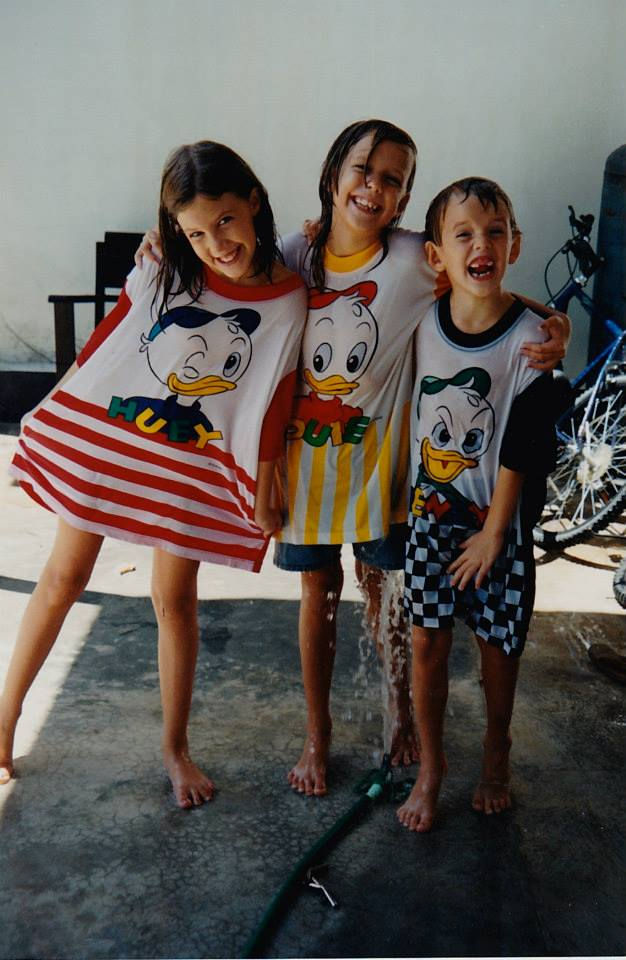
Getting back to the water fights:
My hubby and I no longer participate in such adventures. But when we lived here with our children, we were out there in the streets driving around spraying water or getting sprayed with water.
Do you see the pickup truck in the first photo? The truck box full of people with water guns? That was our family!
In 1997, our first Songkran here, I remember a friend of ours with a supercab truck coming to pick us up. He had two barrels in the back that we filled with water. We grabbed our water guns, piled in, and away we went.
It would take us 3-4 hours to get around the moat (the best place to go). Considering each side of the moat is only 1 km in length, you can guess how fast we were going AND, how wet we were by the time we got home!
Then on days we weren't driving around (when my hubby and I had had our fill), our kids would take their water guns out to the busy street in front of our house, and spray anyone and everyone, whether vehicle or pedestrian. During Songkran, everybody's fair game, including policemen.
I learned early that if you don't want to get wet, don't go out. And if you get wet, don't get angry (at least don't show your anger). Just smile and move on!
So now you understand why my Drink of the Day is water.
And now I'm really thirsty. Time to go get some of that "Pure Life."
I find preparing for a language proficiency test easier to think about when there is a concrete question to start from. Practising the task format can help a learner focus on language rather than unfamiliar instructions. I would keep that thought nearby when looking for ideas about language test preparation. I would probably come back to this question after trying to work through one concrete example rather than deciding immediately. How would you balance test practice with everyday language use?
The topic of understanding community involvement in education gives me a few things to think about, especially when the discussion moves beyond general advice. A school community grows through ordinary opportunities to work together. This is why I would approach community school involvement with a specific question rather than a fixed expectation. I can imagine different answers depending on the situation, so I would want to understand the context before drawing conclusions. How can families contribute ideas without needing large amounts of free time?
Considering learning to explain a technical idea simply, I keep coming back to the difference between knowing about an idea and putting it into practice. A short explanation can become clearer when it follows the order in which a beginner meets a problem. It makes me curious about the practical side of technical communication skills. The part I would like to explore further is what happens when the idea meets a real situation with its own limitations. What would you explain first before introducing a new technical term?
The theme of making printed information clearer makes me curious about what people notice in their own everyday experiences. Readable spacing and a clear hierarchy can change how easily someone finds a detail on a page. For Mailandbros, I would use practical print design as a starting point for a closer discussion of the subject. That is the part I would keep thinking about after moving on to something else. What would you check on a printed draft before producing more copies?
When it comes to keeping personal care simple and thoughtful, one clear example can stay with me longer than a long list of general points. A small consistent habit can be easier to assess than several unfamiliar changes introduced together. That thought gives me a starting point for exploring personal care ideas in connection with Mafelicita. I would rather explore one useful example carefully than pretend that the whole subject is already clear. What would help someone decide which parts of a personal-care routine are useful to them?