


Chp 16: Start with Why
Updated: Feb 1, 2024
A couple of years ago I read Simon Sinek's book, Start with Why. As our time here draws to a close, I thought it time to answer the question, "Why are you in Thailand, anyway?"
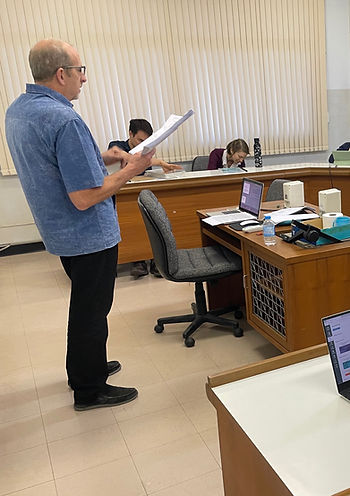
Five days a week my hubby heads off to school--not as a student but as a professor of linguistics, teaching a "Translation Principles" class to (this year) ten multi-cultural students. Many of these students have already joined our organization or an affiliate organization--with the goal of helping with Bible translation, literacy, survey, ethnomusicology and other related work.
All these students need one-on-one advising with their final thesis paper as they take that final step to graduation. This is also something my hubby does--and finds very fulfilling.
As my hubby works, I come alongside future students and current students, and offer help in a different way.
English is not the first language of a number of these students. In fact, it's often their third or fourth language. So, sometimes these students need help improving their English to get into the program or need help with editing their papers--and help I do because I want them to succeed.
And sometimes I simply "help" by baking cookies for them to enjoy in class--just cuz I like to see their smiles.
We've seen years of students graduate and move on to do amazing things for God worldwide. This fills our hearts with so much joy, and helps us answer "why."
But of course, there's another BIG reason why we're here--to do Bible translation!
Since 2005, my hubby has worked tirelessly with one main national translator and a small team of other nationals in what we used to call the Shatikha language, a language group in a neighbouring country.

But now, we can actually called them by their real name--the Khamti Shan people. That's because as of a few weeks ago, the Khamti New Testament is on an internationally-recognized Bible App.
Here is a screen shot of Mark chp. 1. Isn't the script beautiful? Almost like curled brush strokes on a page. It makes my artsy brain so happy. And to know that these are God's Words, written so artfully, fills my heart with wonder and awe at His creativity in the written Word. Wow!
And here's a short recording of what these verses sound like:
God's Word both spoken and written for the Khamti people--in the language that speaks to their hearts! Again, WOW!!!

THIS is why we joined Wycliffe Bible Translators 35+ years ago!
THIS is why we're living in "exotic" Thailand--not as tourists but as servants of God, following His calling on our hearts to give His Word, and offer His love, to THIS minority language group.
The Khamti people!
When it comes to connecting literature with everyday school questions, I would rather understand one useful detail properly than rush through a long list of ideas. A literary character's choices can provide a starting point for discussing ordinary dilemmas. Seen this way, Prus literature education becomes a topic to explore rather than something to sum up too quickly. I am more curious about the process than a polished result, because the steps in between are usually where questions appear. How would you invite students to support their interpretation with specific details?
There is something approachable about discussing exploring student choice in democratic education through situations people can actually picture. Choosing an activity can involve discussing responsibilities as well as personal preferences. That connection helps me see why democratic education ideas can be worth a closer look. I am still thinking through the details, and a small example would help me picture how this works in practice. How can a learning community make decisions that include quieter voices?
I can see why developing useful skills through small tasks would invite discussion, since different people will bring different experiences to the same question. Completing a modest task can show which parts of a new skill still need attention. It also gives the phrase practical skills development a clearer meaning than a label on its own. I would be interested in a simple example, because it is often the ordinary details that make an idea memorable. How do you choose an exercise that tests understanding rather than memory alone?
My first thought about understanding civic spaces and public communication is that the everyday experience deserves as much attention as the larger explanation. A public information page becomes easier to use when its purpose is clear from the start. I would keep that thought nearby when looking for ideas about civic information literacy. I am more curious about the process than a polished result, because the steps in between are usually where questions appear. What helps visitors find the information they need without already knowing the system?
Thinking about understanding materials and practical workshop tasks, I find the smaller practical questions more interesting than a quick conclusion. Knowing what a component needs to do can make choosing a material easier to discuss. That practical perspective helps me frame practical technical skills as a theme for Jualpipapvc. The smaller details are what I would want to return to, especially when an explanation feels too broad. Which questions should come before comparing different technical options?